
Jio Platforms Share Price Outlook: Four Growth Drivers and Key Risks
Explore Jio Platforms’ stock-market debut, its telecom leadership, broadband expansion, digital services opportunities, and the major risks investors should watch.
Introduction
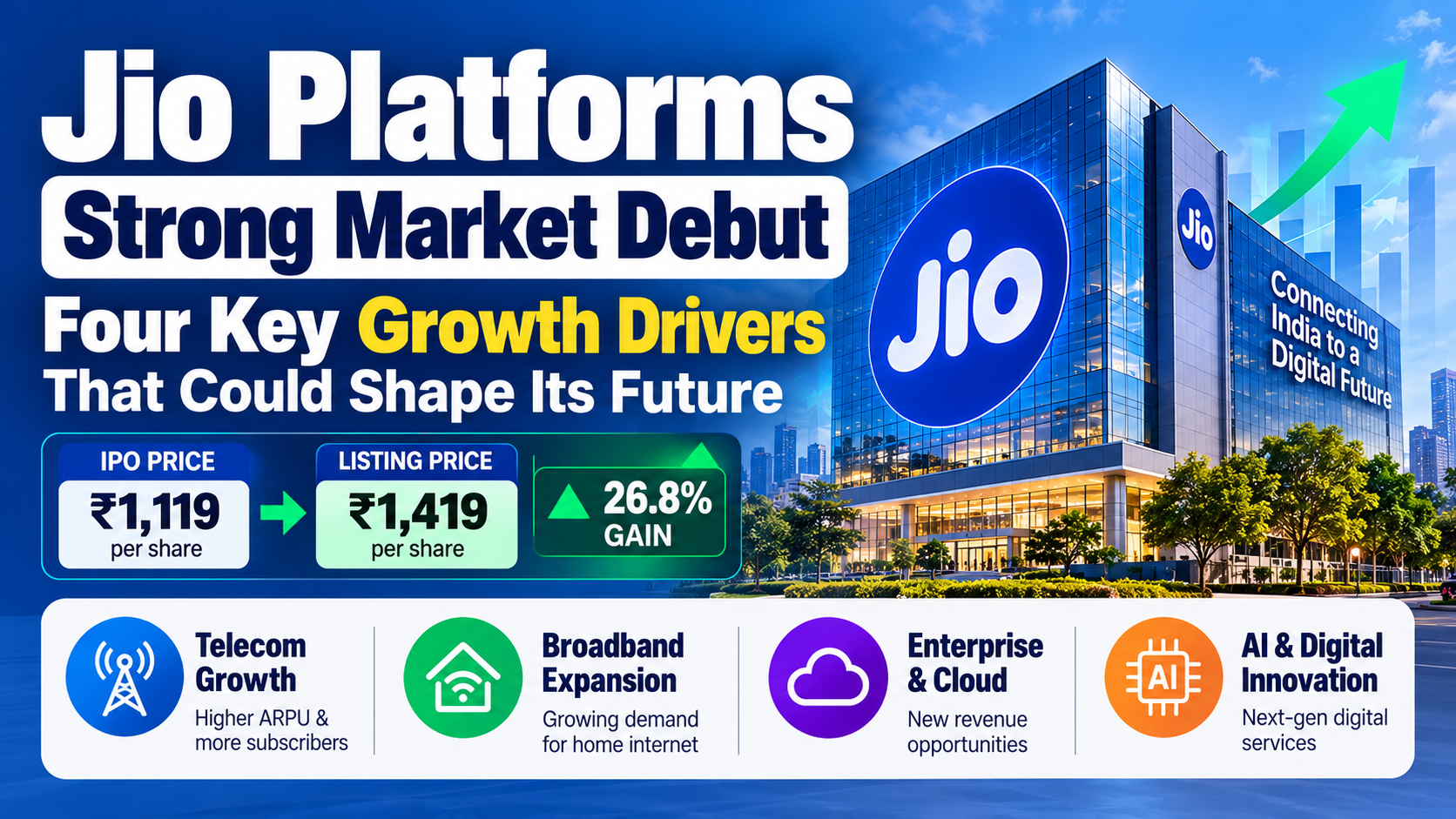
Jio Platforms has made a major entry into India’s public equity markets, bringing its telecom and digital-services business into sharper focus for investors. Its market debut on October 28, 2026, attracted considerable attention, with shares closing at ₹1,419 against an IPO price of ₹1,119.
The listing reflects strong investor interest in a business that combines a large telecom customer base with ambitions in broadband, enterprise technology, cloud computing and artificial intelligence.
However, a strong debut does not automatically mean that a stock will continue rising. To understand Jio Platforms’ potential, investors need to look beyond its initial share-price performance and examine the business drivers that could support future earnings.
Jio Platforms’ Stock-Market Debut: What Happened?
Jio Platforms entered the stock market following substantial demand for its initial public offering (IPO). Its first trading session marked an important milestone for India’s telecom and digital-services industry.
Key figures from the debut include:
- IPO issue price: ₹1,119 per share
- Closing share price: ₹1,419 per share
- Gain over the IPO price: Approximately 26.8%
- Reported market capitalisation: Approximately ₹13.1 lakh crore at the close
These figures illustrate the enthusiasm surrounding the listing. Nevertheless, market capitalisation represents the market’s valuation of a company’s equity; it is not the same as cash available to the business or its annual profit.
The next stage will be more important: whether the company can convert its customer reach and investments into sustainable revenue, stronger profitability and long-term shareholder value.
Four Potential Growth Drivers for Jio Platforms
1. Telecom Revenue Growth and Pricing Opportunities
Telecom connectivity remains central to Jio’s business. A large subscriber base provides the company with an opportunity to generate recurring revenue from mobile services.
Future growth could come from higher average revenue per user (ARPU), additional customer additions, increased data consumption and changes in telecom tariffs.
If the company can increase revenue per customer without losing too many subscribers to competitors, it may improve its revenue and operating profitability.
However, tariff increases are not guaranteed to produce better results in every situation. Competitive pricing, customer affordability and subscriber retention will all influence the outcome.
What investors should monitor: ARPU growth, subscriber trends, customer churn and telecom revenue growth.
2. Expansion of Home Broadband Services
Demand for reliable, high-speed internet is growing as households use more connected devices, streaming platforms, online education and digital services.
Jio’s home broadband offerings could help it capture a larger share of this market. Broadband also creates opportunities to develop relationships with customers beyond mobile connectivity.
A successful expansion could increase recurring revenue and allow the company to offer additional digital services to households.
The main challenges include installation costs, network expansion, service quality and competition from other internet providers.
What investors should monitor: Broadband subscriber additions, revenue per connection, customer retention and the cost of expanding the network.
3. Enterprise Technology and Cloud Computing
Businesses increasingly require cloud infrastructure, secure connectivity, data management and technology solutions to modernise their operations.
Jio Platforms could benefit by providing enterprise connectivity, managed technology services, cloud-related solutions and Internet of Things (IoT) capabilities.
Corporate customers may also create opportunities for longer-term service contracts, potentially diversifying revenue beyond individual mobile subscribers.
However, enterprise technology is a competitive market. Winning customers will depend on pricing, service reliability, product capabilities and the company’s ability to deliver solutions at scale.
What investors should monitor: Enterprise revenue growth, new customer contracts, recurring service revenue and the profitability of technology offerings.
4. Artificial Intelligence and Digital Innovation
Artificial intelligence is creating new opportunities across telecommunications, business automation, customer support, analytics and digital infrastructure.
Jio Platforms could explore these opportunities by combining its connectivity network with digital products, cloud capabilities and partnerships.
Over time, commercially successful AI and digital services could create additional revenue streams beyond traditional telecom operations.
Still, AI represents an opportunity rather than a guaranteed source of profit. Developing infrastructure and launching new products can require significant investment, and adoption may take longer than expected.
What investors should monitor: Commercial launches, paying customers, digital-services revenue, capital expenditure and evidence that new products are improving earnings.
Financial Performance Matters More Than Initial Excitement
Investors should assess whether Jio Platforms’ financial performance supports its market valuation.
Several indicators deserve attention:
- Revenue growth: Is the company consistently increasing sales?
- EBITDA margin: Is operating profitability improving or remaining stable?
- Net profit: Is earnings growth supported by the underlying business?
- Free cash flow: Is the company generating cash after operating expenses and capital investment?
- Capital expenditure: How much money is required to expand networks and develop new services?
- Valuation: Does the current share price appear reasonable relative to expected future earnings and comparable businesses?
A company can have an attractive long-term business model and still be an expensive investment if its share price already reflects very optimistic expectations.
For this reason, investors should review the latest exchange filings and financial statements rather than relying exclusively on listing-day performance or market commentary.
Key Risks Investors Should Understand
Jio Platforms’ growth prospects must be evaluated alongside several risks.
1. High valuation: A premium valuation can leave less room for disappointment if earnings growth falls short of expectations.
2. Competition: Telecom operators and technology companies compete for customers, enterprise contracts and digital-services revenue.
3. Regulatory changes: Telecom licensing, spectrum costs, data protection requirements and other regulations can affect operating expenses and business strategy.
4. Capital expenditure: Network upgrades, broadband deployment, cloud infrastructure and AI investments can consume substantial cash.
5. Execution risk: New businesses may take longer to become commercially successful than management expects.
6. Share-price volatility: Strong demand during an IPO does not eliminate the possibility of subsequent price corrections.
Investors should also distinguish between short-term trading momentum and the company’s long-term ability to generate cash and profits.
Is Jio Platforms a Long-Term Investment Opportunity?
Jio Platforms offers exposure to several potentially important areas of India’s digital economy: telecom connectivity, home broadband, enterprise technology and AI-related services.
The long-term investment case would become stronger if the company demonstrates sustained earnings growth, disciplined capital allocation, healthy cash generation and successful expansion into higher-value services.
On the other hand, a high valuation, slower-than-expected monetisation or aggressive competition could limit future returns.
Rather than deciding solely on the strength of the IPO debut, investors can assess the business against their investment horizon, risk tolerance and valuation expectations.
Short-term traders may focus on price action, trading volumes and volatility, while long-term investors should place greater emphasis on financial results, cash flows and the sustainability of growth.
Conclusion
Jio Platforms’ stock-market debut is a significant development for India’s telecom and digital-services industry. Its potential growth drivers include telecom pricing opportunities, home broadband expansion, enterprise technology and AI-enabled services.
The important question now is whether these opportunities can translate into durable financial performance.
Investors should track quarterly results, business updates, competitive developments and valuation before making an investment decision. A successful listing can create visibility, but long-term shareholder returns ultimately depend on business performance and the price paid for the shares.
Disclaimer: This article is for educational and informational purposes only. It is not investment advice or a recommendation to buy, sell or hold any security. Stock-market investments involve risk, including possible loss of capital. Readers should conduct their own research and consult a SEBI-registered investment adviser where appropriate.