
Introduction
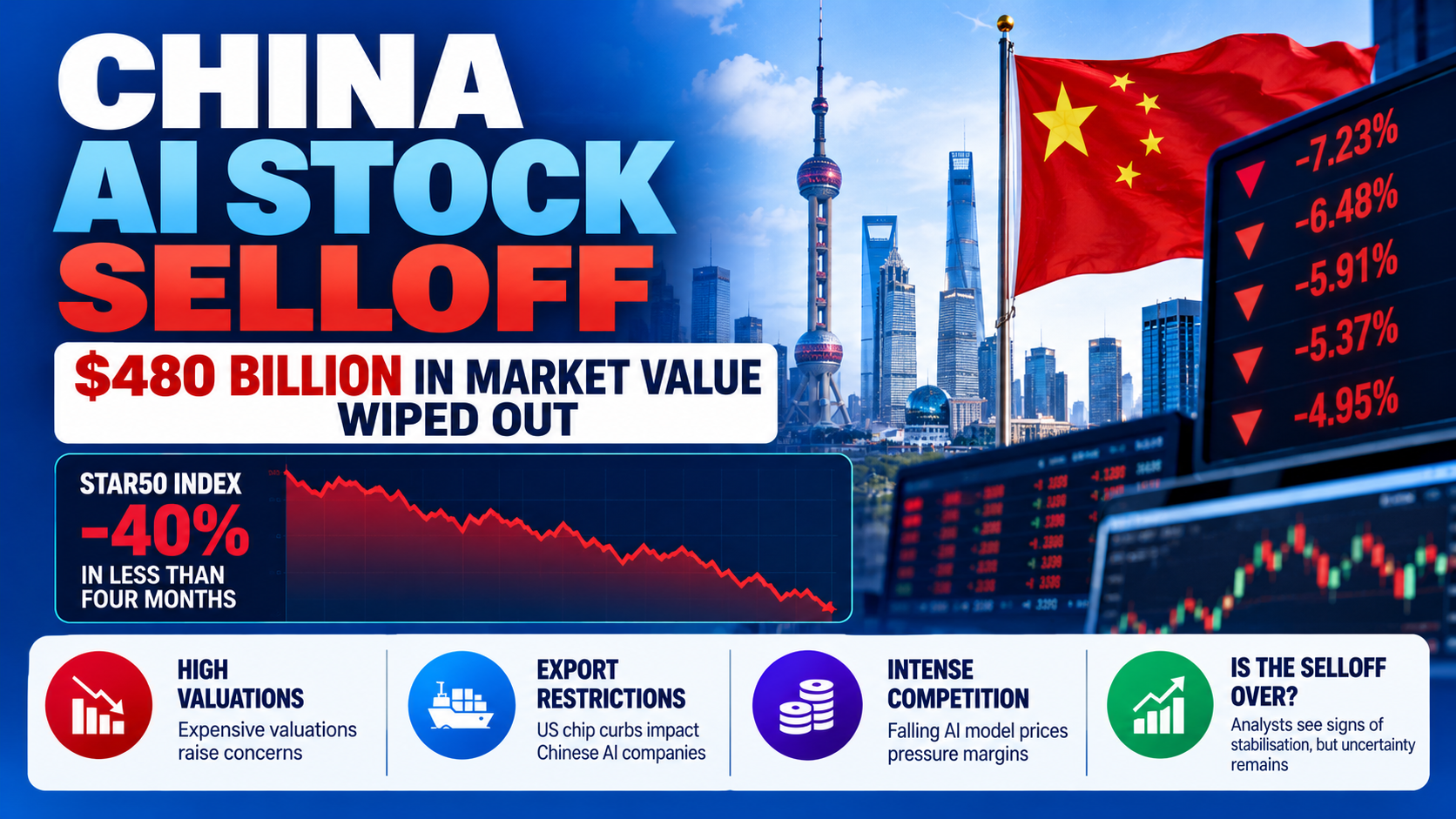
China’s artificial intelligence (AI) investment boom is facing a major reality check. A sharp decline in Chinese AI and semiconductor shares has erased approximately $480 billion in market value, raising questions about whether technology stocks had climbed too far ahead of their underlying business performance.
The correction follows a powerful rally driven by investor expectations for AI adoption, semiconductor development and China’s ambitions to strengthen its position in advanced technology.
However, enthusiasm has increasingly collided with concerns about expensive valuations, export restrictions, intense competition and uncertainty over future demand.
For investors, the central question is no longer simply whether AI will transform the global economy. It is whether companies developing AI technologies can generate enough sustainable revenue and profit to justify their market valuations.
What Happened to China’s AI Stocks?
Chinese AI and semiconductor stocks have experienced a substantial reversal after an extended period of gains.
According to market reporting published on October 28, 2026, the selloff erased approximately $480 billion in combined market value. The STAR 50 index, which tracks major technology and semiconductor companies, fell around 40% in less than four months, while the broader CSI 300 index declined approximately 20% from its June highs.
These figures illustrate the scale of the correction and the pressure facing investors who bought during the rally.
The decline does not necessarily mean that AI technology has lost its long-term potential. Instead, it suggests that investors are reassessing how much they should pay for that potential and how quickly companies can turn innovation into profits.
Four Major Reasons Behind the Selloff
1. High Valuations Created Greater Downside Risk
One of the principal concerns is that many AI-related shares had become expensive after a strong rally.
When share prices rise much faster than earnings, investors increasingly depend on expectations of future growth. If those expectations weaken, valuations can contract quickly.
Market reporting indicated that the STAR 50 index was trading at approximately 100 times trailing earnings following the correction, down from a peak near 250 times earnings. This remains a demanding valuation compared with many established equity benchmarks.
High valuations do not automatically mean that a company is a poor investment. However, they can leave less room for disappointing earnings, slower growth or changes in market sentiment.
What investors should monitor: Price-to-earnings ratios, revenue growth, profit margins, earnings forecasts and the relationship between market value and actual business performance.
2. Export Restrictions Are Creating Uncertainty
Restrictions affecting advanced chips, semiconductor equipment and technology exports represent another potential challenge for Chinese AI companies.
Access to advanced computing hardware is important for training and operating sophisticated AI systems. Changes in international trade policy can affect equipment availability, development costs and the ability of companies to serve certain customers.
Restrictions affecting Chinese technology suppliers’ access to overseas markets can also create uncertainty about future sales and expansion plans.
The actual impact varies by company. Businesses with strong domestic demand, alternative supply chains or competitive products may be better positioned than those that depend heavily on restricted markets or imported components.
What investors should monitor: Changes in export regulations, semiconductor supply chains, equipment access and overseas customer demand.
3. Fierce Competition Could Pressure Profit Margins
China’s AI ecosystem includes multiple companies competing to develop models, chips, computing infrastructure and commercial applications.
Competition can accelerate innovation and lower costs for customers. However, it can also make it harder for companies to maintain high margins.
If competitors repeatedly reduce prices to attract users, businesses may need to spend more on research, infrastructure and customer acquisition while earning less from each service.
This creates a potential challenge for investors who expect rapid revenue growth to translate directly into stronger profits.
What investors should monitor: AI service pricing, customer retention, market share, operating costs and evidence of sustainable profitability.
4. Investors Are Questioning the Pace of AI Demand
AI adoption continues to create opportunities across business software, automation, data centres and digital services. Nevertheless, investment expectations can move faster than actual customer spending.
Companies may invest heavily in infrastructure before they have sufficient recurring revenue to justify those costs. If commercial demand develops more slowly than expected, investors may reassess the earnings potential of both AI developers and their suppliers.
This is particularly important for businesses that require substantial capital investment or depend on continued spending by large technology companies.
What investors should monitor: Paid AI users, enterprise contracts, recurring revenue, infrastructure utilisation and returns on invested capital.
Which Companies and Sectors Are Under Pressure?
The correction has affected different parts of China’s AI and semiconductor ecosystem, including chipmakers, AI hardware suppliers and robotics businesses.
Market reporting has highlighted declines in several companies following earlier rallies. Some AI hardware and optical-component suppliers have also faced pressure amid concerns about restrictions affecting their access to overseas markets.
These developments demonstrate why investors should not treat all AI-related businesses as identical.
A semiconductor manufacturer, an AI model developer and a robotics company may have very different revenue sources, costs, competitive advantages and capital requirements.
Investors should examine each company’s financial statements, market position and exposure to policy changes before drawing conclusions about its prospects.
Is China’s AI Stock Bubble Finally Bursting?
A sharp fall in share prices is not, by itself, proof that an entire industry was a bubble.
To assess whether valuations had become excessive, investors need to compare market prices with underlying business fundamentals.
Warning signs can include:
- Share prices rising substantially faster than earnings.
- Valuations depending on exceptionally optimistic growth assumptions.
- Companies struggling to generate positive cash flow.
- Increasing competition reducing pricing power.
- Heavy investment without clear evidence of commercial returns.
When several of these factors occur together, a correction can become more severe as investors reduce their growth expectations.
At the same time, a market decline can create opportunities in companies whose underlying businesses remain competitive and whose valuations have become more reasonable.
The distinction between speculative enthusiasm and genuine long-term value depends on company-specific evidence, not simply on how far a stock has fallen.
Is the Selloff Over?
It is too early to conclude that the correction has definitively ended.
A sustained recovery would likely require stronger confidence in earnings, more attractive valuations and evidence that AI companies can maintain demand despite growing competition.
Several developments could influence the market’s direction.
Potential recovery factors
- Improved earnings and revenue guidance.
- More reasonable share valuations.
- Successful commercial launches of AI products.
- Greater clarity on export rules and technology supply chains.
- Evidence that customers are willing to pay for AI services.
Factors that could extend the decline
- Further reductions in AI-related product prices.
- Earnings disappointments.
- Additional restrictions affecting technology exports.
- Continued pressure on profit margins.
- More attractive investment opportunities elsewhere.
Some investors may view the correction as an opportunity to accumulate shares selectively, while others may prefer to wait for more evidence that valuations and earnings expectations have stabilised.
Neither approach guarantees a positive outcome.
What Does the China AI Selloff Mean for Global Markets?
China’s technology sector is an important part of the global AI investment landscape. A prolonged correction could influence sentiment toward semiconductor manufacturers, AI hardware suppliers and technology companies in other markets.
However, the effects will not necessarily be uniform.
Companies with strong balance sheets, differentiated products and recurring revenues may be better positioned to withstand volatility than businesses relying heavily on external funding or aggressive growth assumptions.
Investors should also distinguish between a correction in Chinese AI stocks and a broader decline across global technology markets. Each market has different valuations, business models, regulatory conditions and earnings drivers.
For Indian investors, the situation is a reminder to evaluate global technology trends carefully rather than assuming that every company associated with AI will benefit equally.
How Should Investors Approach AI Stocks During Volatility?
Investors considering AI-related stocks can use a structured approach to evaluate risk.
1. Focus on business fundamentals. Examine revenue growth, earnings quality, margins, cash flow and debt.
2. Avoid buying solely because prices have fallen. A lower share price does not automatically mean that a stock is undervalued.
3. Compare valuations with realistic expectations. Assess whether future growth assumptions are supported by evidence.
4. Diversify exposure. Concentrating an entire portfolio in one technology theme can increase risk.
5. Track policy and competitive developments. Export restrictions, supply-chain changes and price competition can materially affect earnings.
6. Match investments to your risk tolerance. High-growth technology stocks can experience significant price fluctuations, even when their underlying businesses remain viable.
These considerations can help investors distinguish between temporary market volatility and deeper deterioration in a company’s business prospects.
Conclusion
China’s AI stock selloff has highlighted the risks that emerge when strong technology expectations meet demanding valuations and uncertain profitability.
The loss of approximately $480 billion in market value underscores how quickly investor sentiment can change when concerns about competition, export restrictions and commercial demand intensify.
Nevertheless, the correction does not establish that AI has no future or that every AI-related company is overvalued. The long-term outlook will depend on which businesses can translate innovation into sustainable revenue, profits and cash flow.
For investors, the most important lesson is to look beyond the excitement surrounding AI. Valuation, financial strength, competitive positioning and the ability to generate lasting returns remain essential when assessing any technology investment.
Disclaimer: This article is for educational and informational purposes only and does not constitute investment advice or a recommendation to buy or sell any security. Investments in equities and technology companies involve risk, including possible loss of capital. Readers should conduct independent research and consult a SEBI-registered investment adviser where appropriate.
Source note: This article is independently written using publicly reported market information and original analysis. It is not affiliated with or endorsed by Mint or Reuters.